Window Cleaning Van Setup UK: Tank, Pump and Layout Guide
Tank size, payload limits, battery wiring and layout. Get the van right once and every working day gets faster.
Practical guides on quoting, pricing and running a window cleaning business, written and reviewed by the Squeegify team.
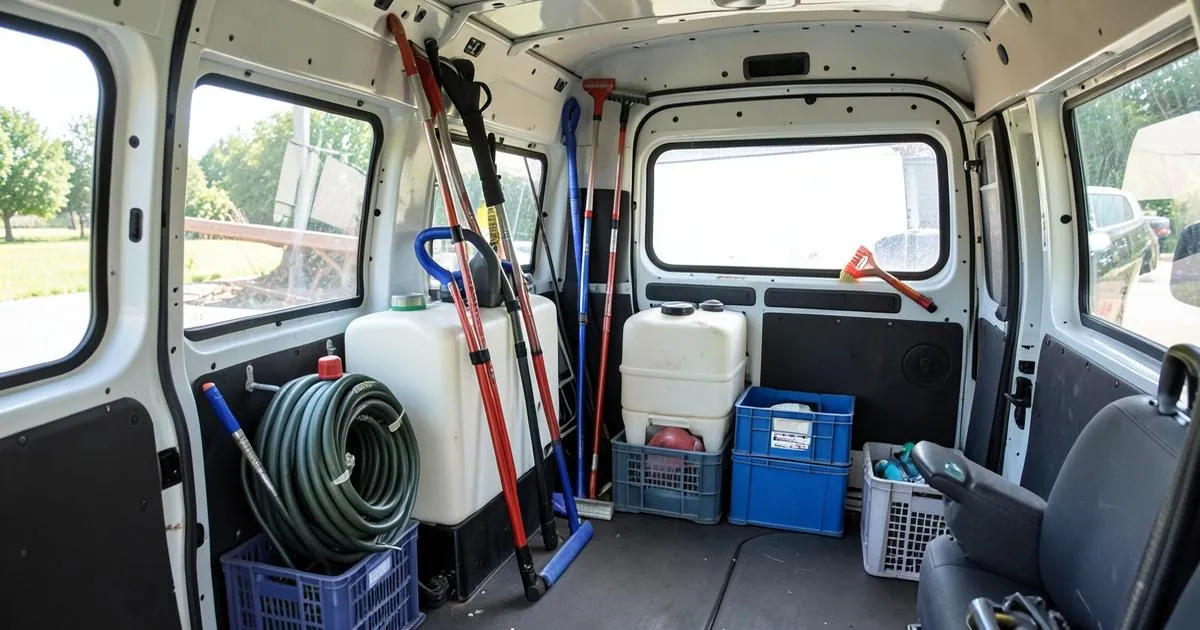
A good one-operator window cleaning van is a 350 to 650 litre baffled tank mounted low and forward of the rear axle, a 12V pump on a dedicated leisure battery with a split charge relay, a wall-mounted hose reel by the side door, and racked poles that come out without unloading anything else. Water weighs a kilogram a litre, so payload, not tank capacity, sets your real limit.
Weight and the law
- Check the payload on your VIN plate, then subtract tank, frame, hoses, kit and yourself.
- 500 litres of water is half a tonne. Many small vans cannot legally carry it once fitted out.
- Overloading invalidates insurance and is an offence: plan around a comfortable margin, not the maximum.
- Fill part-tanks for tight rounds rather than running full every day.
Tank placement
- Mount low, and just ahead of the rear axle, to keep handling predictable.
- Use a baffled tank so water does not surge when you brake.
- Bolt the frame through the floor with spreader plates: straps alone are not enough.
- Leave the outlet and filters accessible without crawling over the tank.
Pump, battery and wiring
- Dedicated leisure battery, split-charge relay from the vehicle, and a proper fuse close to the battery.
- Flow controller so you can dial flow to the job instead of wasting water.
- A mains charger for cold months when short drives never top the battery up.
- Keep the electrics out of the wet zone and label everything for the next person who works on it.
If you shift three items to reach your pole, that's a minute per house. Across a 30-house day and a 5-day week, poor layout costs you hours a month for free.
The layout that works
- Hose reel at the side door, at waist height.
- Poles racked along one wall, longest at the bottom.
- One crate for traditional kit, one for gutter and fascia work, both labelled.
- Spare rubbers, jets, fittings and fuses in a single small parts box: breakdowns happen mid-round.
The part most people forget
A well-built van makes you efficient on the road but does nothing for the enquiries arriving while you're on it. Set the van up once, then set the quoting up once, so a missed call becomes an online quote instead of a lost customer.
Put what you just read to work while you're out cleaning.
You came here to get better at the trade. Squeegify turns that knowledge into a quote form on your own website, so visitors price themselves, book a slot, and drop into your inbox while you're on the ladder. No more lost enquiries because you couldn't answer the phone.